Back to Home Page

Electric Toasters Made in the U.S.A.
during the Roaring Twenties


Home. . . 1920s. . . 1930s. . . 1940s & later. . . Non electric. . . 220 Volt. . .
Classic Appliances . . . Waffle Irons. . . Popcorn Poppers. . . Cookers Fryers. . .
Working but. . . Decorator Special . . . Toast Racks. . . "toasterNotes" Cards. . .
Replacement Cords. . . FAQ. . . Links. . . Recipes . . . Repair Service. . .

Patent granted in September of 1912.

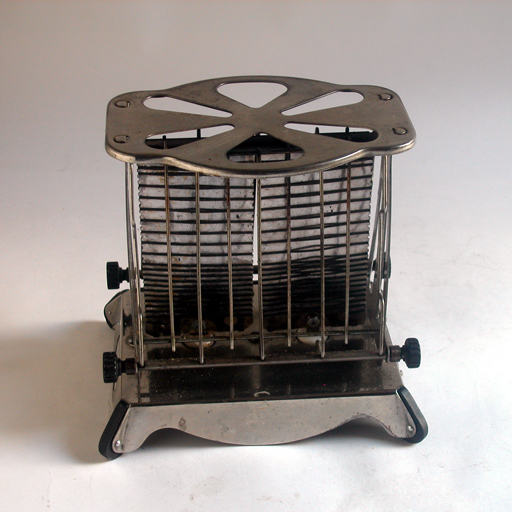
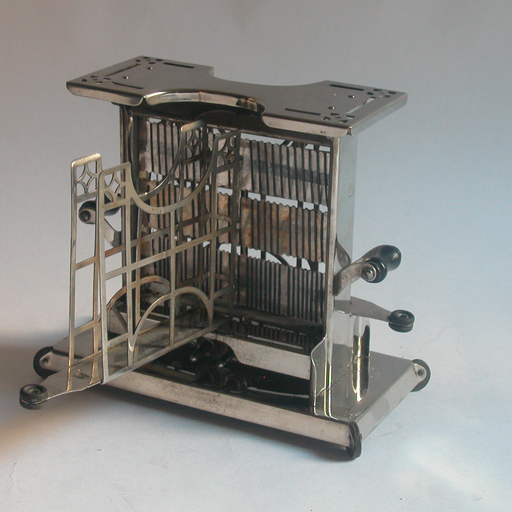
Pelouze Vertical Toaster circa 1912

This is the least common of any toaster for sale here at Toaster Central. Because it is so early, it was still a new-fangled thing.

According to the Charles P. Fisher book on toasters "Edward Schwartz received a design patent on the spidery cabriole-legged percher, which was made by Pelouze Mfg. of Chicago." I think it is interesting that two dates are shown on the badge, for both the patent application date and also the date the patent was granted.

It's a striking piece, even in profile.

And, yes, it still works. It's in beautiful condition with minor repair to the mica plates that is not conspicuous, and otherwise all original. But, this is really a show piece and I'd not recommend using it frequently. Great gift for a patent lawyer, inventor, or someone who already has everything and doesn't need a gift from Sharper Image.

Pelouze Vertical Toaster circa 1912
110 Volta 500 Watts
Pelouze Manufacturing Co. Chicago

$2250

Purchase Information


1920 Thermax Toaster

According to Charles Fisher in Early American Electric Toasters, the frame of this toaster was originally designed by Alonzo Warner, then modified by and patented by James Lamb at Landers, Frary & Clark. It continued in production for at least fifteen years. Later models had different doors, and a slightly different top.

This model was made 1919 to 1923, for those early adopters of technology who had their homes wired for electricity. Many people still used gas light and kerosene lamps. The doors are spring loaded and will accept thick material such as a bagel half or hefty crumpet. The design features the economical three panel design for the heating element.

1920 Thermax Toaster
Landers, Frary & Clark New Britain, Conn.

$285

Purchase Information
Made between 1919 and 1923


The Layfayette pattern from Landers, Frary & Clark.

Toast in a Drawer from the mid-1920s

This toaster came out in the 1920s, right around the time that the famed Toastmaster Automatic Pop-up Toaster hit the market in 1926 and was a huge success. This being America, competition for a share of the market was fierce among manufacturers of small electric appliances. An automatic toaster was a new-fangled thing. The shape is architectural and the decoration is in the Lafayette pattern . Every detail is finished and decorated including the fasteners for the feet decorated with rosettes. This toaster was from one of a whole line of small appliances.

To make toast, first you plug in the cord and the current starts immediately to heating panels; you have to let it warm up for a minute or two.

The controls are located on the narrow side. At the bottom is the drawer handle, then next above is a stop lever which latches into a sawtooth slot to set the degree of doneness. Place the bread in the holder, close the drawer, then push down the upper lever to start the timing clock. It whirs furiously and then a bit erratically while the top lever slowly rises to the starting postion and when it does, it trips a lever to release the drawer which is spring loaded and pops out with the finished toast. The drawer is removable for easy cleaning.

Mind you, the drawer popped open, but the current is still on. It is essentially an oven style toaster with a timer to release the drawer. There is no internal mechanism to turn off the current which would probably have violated the patents held by Toastmaster. So, the toaster comes with a deluxe cord set with a switched plug for ease of use.

This is a good choice for a special gift for an antique collector, patent lawyer, designer, artist, etc. and while it does work, it is not recommended for anything but occasional use. By the way, you can demonstrate the mechanism without plugging in the cord.

Toast in a Drawer
Universal The Brand Name Known In Every Home
New Britain Conn. U.S.A.

$225

Purchase Information


Toastmaster model Automatic Pop-up Toaster

Charles Perkins Strite was the guy in Stillwater, Minnesota who paired a clockworks timer and set of carbon contacts together with heating elements to cook both sides of a slice at once AUTOMATICALLY, without turning or burning as with the manual, fold-down-door models It became a popular product when it hit the home market in 1926 as The Toastmaster, deemed one of the greatest all-time inventions according to American Heritage and others, millions of 'em, people who adore their old Toastmaster.

This single slice unit has two control levers: one pushes down to wind a spring that operates the clockwork mechanism, and the other lever pushes down to lower the bread and starts the current. In addition, there is a spring-loaded stop below the right lever to set the shade of darkness, and a small lever in between the two big levers to pop the toast up before the end of the cycle.

Produced from June 1926 to August 1930
by Waters-Genter Co. Minneapolis, U.S.A. 110 Volts 600 Watts

$185

Purchase Information
Toastmaster model 1A1, the first automatic pop-up toaster


Toast rack mounted on top of the toaster.

Early Toaster with Rack Mounted On Top

Electric toasters had been around for less than a generation when this electric toaster was made in New Britain, Connecticut, by a company known for its high quality cutlery, hotel and hospital ware, and really beautiful early electric appliances.

The detachable cord plugs into the center of the base. The two doors are spring-loaded to clamp the bread against the guide wires and efficiently close to the heat to toast one side of each slice. Then you have to open the door, flip the slice to the other side and finish the toasting. This toaster has the deluxe feature of a built-in toast rack which keeps the finished toast warm while you are making more.

This toaster is in good condition with minor signs of wear. It comes with a deluxe switched cord set. This is one of the few toasters that will handle half a bagel, assuming you want only the cut side toasted.

Universal The Brand Name Known In Every Home
New Britain Conn. U.S.A.

$265

Purchase Information


Red Torrid Toaster

Made in Hartford, Connecticut, this toaster has been used, abused, and seriously neglected, but still makes toast! The red fittings are unusual, and the doors swing from sideto side. The toast shows the pattern from the door.

The condition of the base is especially poor where most of the nickel plating has deteriorated, and the sides are pitted. It comes with a detachable cord set.

Torrid Toaster in Red
Hartford, Conn.

$125

Purchase Information
Red Hot Toast


Westinghouse Turnover Toaster Westinghouse E. & M. Co.  East Pittsburgh, PA.

Westinghouse Turnover Toaster

The earlier version of this toaster, with a ceramic core rather than mica, was advertised for Christmas in 1916, but this toaster dates a few years later when Westinghouse was still in East Pittsburgh, before the move to Mansfield, Ohio. This model has a permanently attached cord which I've replaced and fitted with a bakelite plug.

Turnover Toaster Style N0.284032A
Westinghouse Elec..& Mfg.. Co.
East Pittsburgh, PA. U.S.A.
Volts 100/120 Watts-550.
LMP diamond
Patented 7-28-14 9-25-14
the WEP inside a double circle

$185

Purchase Information


Electroweld from Linn, Mass. circa 1922 - 1925

This is a fairly fancy toaster with colored handles, swinging doors and a rather odd on/off switch that looks like it should be a lamp socket. This one is in good condition and is complete except for what must have been colored fiber feet.

Pat. Nov. 16, 1920 is the only marking on the bottom.

$310

Purchase Information
Circa 1922-1925 made in Linn Mass.


Sweeheart' toaster from 1929 made in New Britain, Connecticut

Universal Push Button Toaster

Very ornate from the late 1920s with push buttons to flip the toast baskets to the other side. It has a nickel-plated body and the drop handles, push buttons, and feet are ivory colored material. It is decorated everywhere. First production circa 1928-1929.

Universal --"The Brand Name Known In Every Home"
Landers, Frary & Clark, New Britain, Conn. U.S.A.
108-116 Volts, 525 Watts

$775

Purchase Information


Manning-Bowman Reversible Toaster

This "reversible" toaster has a cage on each side that opens for loading bread. The cages close with fine spring steel wires.

After one side of the slice is toasted, the whole cage rotates on the horizontal axis to flip the bread from one side to the other, The cage will open on either side.so you don't have to return to position one when the toast is done. This one is in very good condition with the exception of missing paint on the name badge, no doubt the well-intentioned effort of some former owner. It is beautifully crafted by Manning-Bowman & Co., Meridan, Connecticut, with the slogan "MB Means Best". Detachable cord set included.

(badge in poor condition) MB Means Best, Manning-Bowman & Co
Article No. 1225
Meriden, Conn. U.S.A.

SOLD

Purchase Information
The Manning-Bowman Company made many beautiful appliances and was a master metal crafter.


Two great pieces from Hotpoint

Hotpoint Trianon Toaster with Percolator

This pair of electric appliances was quite deluxe for the time, well out of the reach of the average wage earner. Some electric companies offered to sell them on time for twenty-five cents a week, for the aspirational crowd of the day. This one is called the Trianon pattern.

The toaster's cathedral design on the doors is very pleasing, and the pattern repetition foretells the art deco use of repetition and geometry.

The base of the toaster is signed in script. The heating elements are vertically laced and hook to offset insulators. It is in good condition with the exception of missing black paint on some handles.

The percolator styling is a graduated swag motif, classically pleasing.

Both of these appliances were made with flat spades, before the standard was round pins; the correct plugs are very hard to come by, so this pair comes with one cord set that fits both the toaster and percolator.

Early Electric Hotpoints -- Toaster and Percolator

SOLD

Purchase Information


The "E-Z TURN" Toaster

I believe this toaster is from the late 1920s, but with a rather art nouveau motif which was popular several decades earlier. The toaster sports nickel plating and turned up feet with nearly concealed fiber feet, and a nice name badge. mounted on the base. There is a mechanism to flip the slice to toast the other side when the door is opened and closed, hence the name. It is in good condition and comes with a detachable cord set.

I've seen this same toaster called the BEE-VAC from the Birtman Electric Company in Chicago which sold vacuum cleaners. It is well constructed of sturdy materials into a very pleasing design.

$125

Purchase Information
Also known as a BEE-VAC


Deluxe version has a toast rack on top

Manning-Bowman Quality Toaster

I believe this toaster is an example from the early 1920s and is remarkable for the built-in toast rack on top. It is in remarkably good condition with minor flaws in the plating. It has fiber feet and two exposed male spades.

But just open the spring loaded door (great for clamping half a bagel to the heat) and you can see the interior arrangement. Behind the vertical guard wires is a rectangular ceramic frame around which the heating wire is wrapped. Some early electric toasters used ceramic in one form or another but most used mica plates to support the nickel resistance wire.

Manning Bowman Quality
Volts 110 Amps 4 Serial No. 16394
Article No. 1210 (overstrike with 16272 underneath)
Meriden, Conn. U.S.A.

SOLD

Purchase Information


Westinghouse Toaster from the early 1920s

This toaster could be called the Ipod of its day. It is a fancy version because there is a clockworks timing mechanism. You set the lever on the right for how Light or Dark you want the toast, the cock the lever on the left and the current turns on and the clock ticks away. At the end a bell rings, and a switch turns off the current "automatically." Most toasters were still entirely manual, but this Westinghouse was as modern as a flapper beads, The Charleston, and bobbed hair and the new Studebaker to haul you off to the local speakeasy. Or church.

The toaster is plated in nickel with punched fiber handles and fiber feet. The pierced doors have an 1920s swag motif. The condition is very good, but there are signs of use and wear.

Westinghouse Turnover Toaster
Cat. No. TT-23
Mansfield, O.

SOLD

Purchase Information
Westinghouse Toaster in the


Thrill your family in the morning with the Estate Electric Toaster.

The Estate Electric Toaster

Advertised in 1924, this early electric four-slice toaster for the home has four cages that simulaneously rotate 270 degrees in order to toast first one side and then the other side of all four slices. It is a real crowd-pleaser.


This one is in quite good condition, retaining its nickel plating which is usually quite deteriorated, with very minor corrosion. Its original cord is still in good shape and should be treated as fragile, It sports a nice badge on the base.

The Estate Stove Company, Hamilton Ohio,
Patents Pending. 110 Volts, 5.5 Amps

$265

Purchase Information

Home. . . 1920s. . . 1930s. . . 1940s & later. . . Non electric. . . 220 Volt. . .
Classic Appliances . . . Waffle Irons. . . Popcorn Poppers. . . Cookers Fryers. . .
Working but. . . Decorator Special . . . Toast Racks. . . "toasterNotes" Cards. . .
Replacement Cords. . . FAQ. . . Links. . . Recipes . . . Repair Service. . .
Contents © 1999-2008 MichaelSheafe